


Most ecommerce founders can quote their monthly revenue from memory. Ask them about inventory turnover and you usually get a pause. The team at Legend Bookkeeping sees this gap constantly with online sellers, especially Shopify brands moving past their first $500K in annual sales. Revenue gets attention because it’s visible. Inventory sits in a warehouse or a 3PL invoice, quietly absorbing cash, and by the time anyone runs the numbers there’s $40,000 of dead SKUs aging on shelves while the founder is wondering why payroll feels tight.
Inventory turnover is one of the most useful financial metrics a product-based business has, and it’s also one of the most ignored. Understanding what your turnover ratio actually means is the difference between running a business that generates cash and running one that turns every dollar of profit into another box of unsold goods.
How to Calculate Inventory Turnover
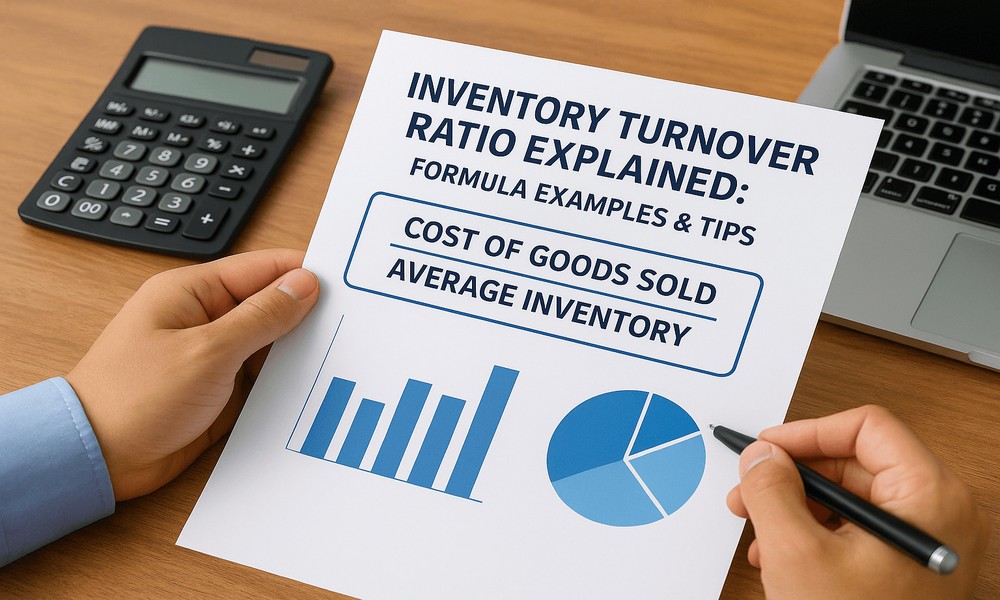
The formula itself is straightforward. Inventory turnover equals cost of goods sold divided by average inventory, both measured over the same period (usually a year).
Take a hypothetical apparel brand. Annual COGS comes in at $480,000. Average inventory across the year, calculated by adding the start-of-period and end-of-period inventory values and dividing by two, sits at $120,000. Turnover ratio is $480,000 divided by $120,000, or 4. The business turns its inventory four times per year.
Days inventory outstanding (DIO) is the same idea expressed in days. Take 365 and divide by your turnover ratio. Four turns per year equals roughly 91 days of inventory on hand at any given time. That number is often more intuitive than the ratio itself, because it tells you how long the average dollar of inventory is sitting before it sells.
What Healthy Looks Like by Category
There’s no universal benchmark. A turnover ratio of 4 is excellent for one category and concerning in another. The right way to think about it is by industry and product type.
Apparel and fashion typically run 4 to 6 turns per year for established brands. Fast fashion can hit 8 or higher. Niche or premium apparel often runs lower, in the 3 to 4 range, because slower-moving inventory carries higher margins.
Supplements and consumables tend to land between 6 and 10 turns. Shorter shelf life, repeat purchase patterns, and tight margins push these brands toward higher turnover.
Consumer electronics and accessories vary widely. Commodity electronics often need 8 to 12 turns to be profitable because margins are thin and product cycles are short. Specialty electronics with longer product lives can sustain 4 to 6.
Home goods, kitchenware, and furniture run lower, typically 2 to 5 turns, because higher unit prices and longer purchase cycles mean inventory naturally sits longer.
Beauty and skincare brands tend to run 5 to 8 turns when the product mix is healthy. SKUs that consistently turn slower than the rest of the catalog usually deserve a closer look.
These ranges are starting points. The more important comparison is your business against itself over time. Is your turnover ratio improving, flat, or declining quarter over quarter? That trend matters more than hitting any specific benchmark.
Why High Turnover Isn’t Automatically Good
A turnover ratio that looks great can also signal stockouts, missed sales, and customer frustration. A brand turning inventory 14 times a year is moving product fast, but if customers regularly hit “out of stock” pages or backorder delays, the business is leaving revenue on the table and pushing buyers toward competitors.
The healthiest pattern is steady turnover with strong fill rates. You want product moving consistently and you want it available when customers want to buy. If your turnover ratio is climbing while customer reviews start mentioning shipping delays or stockouts, the high number is hiding a service problem.
Why Low Turnover Quietly Destroys Cash Flow
Low turnover is the more common issue, and it’s the one that catches founders off guard. Inventory is one of the largest uses of cash in a product business, and it doesn’t show up as an expense on the P&L until it actually sells. A brand sitting on $80,000 of inventory at the start of the year and $180,000 at the end has spent $100,000 of cash on goods that are still in the warehouse.
That’s $100,000 that isn’t available for payroll, ad spend, or the next product launch. It’s also $100,000 of risk, because slow-moving inventory tends to become obsolete inventory, and obsolete inventory either gets discounted or written off.
Owners often look at a profitable income statement and wonder why the bank account keeps shrinking. The answer is usually some combination of growing AR, large equipment purchases, and inventory creep. Inventory is the quietest of the three because it doesn’t trigger any alerts in your accounting software.
How to Actually Improve the Ratio Without Slashing Prices
A few practical moves typically move the needle:
- Run a SKU-level analysis quarterly to identify the bottom 20% of products by velocity. These are usually the ones eating cash.
- Tighten reorder quantities for slow movers. Just because the supplier minimum is 500 units doesn’t mean the business should hold 500 units of a SKU that sells 30 a month.
- Bundle slow-moving items with strong sellers rather than discounting them. This protects margin while clearing inventory.
- Use seasonality data from previous years to plan purchasing. Most ecommerce businesses overstock for Q4 by margin and then carry the excess through Q1 and Q2.
- Negotiate shorter lead times with suppliers when possible, even at slightly higher unit costs. Faster reorder cycles mean less safety stock and better turnover.
Drastic markdowns work but should be a last resort. They train customers to wait for sales and erode brand pricing power.
How Legend Bookkeeping Helps Ecommerce Brands See the Numbers Clearly
Most Shopify, Amazon, and multi-channel sellers don’t have a real-time view of inventory turnover because the data lives across platforms that don’t talk to each other cleanly. Legend Bookkeeping uses tools like A2X to standardize sales and COGS data flowing into the accounting system, which makes the resulting financial statements actually accurate enough to calculate inventory metrics that mean something. Reports like Shopify’s inventory analytics combined with clean accounting data give founders the picture they need to make purchasing and pricing decisions before cash gets tight.
If your ecommerce or product business is growing but cash feels tight, inventory is usually the first place to look. Legend Bookkeeping works with online sellers across categories to clean up the books, surface real inventory metrics, and turn turnover ratios into decisions instead of after-the-fact regret. Schedule a call to see what your numbers actually look like.
